Monday, May 23, 2011

Natural Soda-Pop Recipe


Our children learned as following scientific facts through making natural soda-pop.


1. Gas solubility is high when higher pressure and lower temperature.


Needed materials : Bottle with lid not to leak air. If wrap the lekage of bottle, it will be higher pressure.


And, ice can be lower temperature in bottle.


Citric acid can be extracted from the juice of oranges, lemons but you can buy it easily from drug store.


And baking soda ~ The bubbles coming up from the bottom of bottle is "Carbon dioxide" gas.


and orange to add taste.


Tuesday, May 17, 2011

Wasp vs Bee


Wasp has waist separate thorax and abdomen.


And they can beat their wings 130 times per 1 second.


Average bee can beat 80 times per 1 second.


And, wasp like to live in solitary.


So you can see them on window in sunny spring days.


After hibernation in winter.


Monday, May 9, 2011

How do plants absorb water?


Flowers absorb water through the xylem found on the stem of plants.


The xylem is to transport water and nutrients from the roots to all parts of the plants.


This process is called "Capillary action".


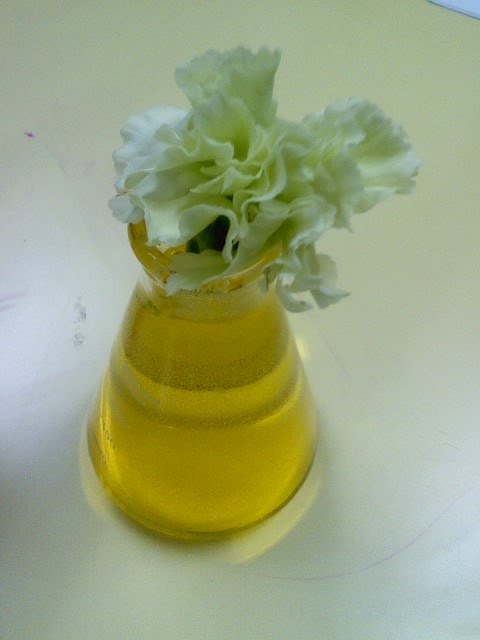
As photo, you can change the color of carnation. (The white petal is ready to change to light yellow)


And, solar energy pull the water up through the plant. Sunlight evaporates the water from surface. This transportation process is called "Transpiration".


The top of the xylem tube become empty from the loss of water, creating a vacuum so water rises to fill empty space.


If you want to mix color, note attached photo.


Monday, April 25, 2011

Making fog


When you add vinegar and baking soda, you can make volcano eruption~~


Making bubble~~

Add liquid dish soap with dry ice and warm water..


When you place dry icce into some warm or hot water, clouds of white for are created.


This white fog is not carbon dioxide gas, it is condensed water vapor mixed in wih the invisible CO2.


The fog is heavy being carried by the CO2.


Sunday, April 17, 2011

Snail Anatomy II


Last year of Apr, a little girl donated her 2 snails to us as shown beside photo.


And then, they laid egg as photo.


After about 45 days, they hatched out.

I donated the small snail to a child, she has cared well until now.


Her snail grow up to about 10 times bigger size


Last week, she showed her snail to me and asked..


Would you find a friend of snail ?


Her snail is alone so it looks some solitary.


Sujeong who 8 years old girl was very shy girl at first.


Even she was scared at seeing and touching small insect and fish.


Now she is thankful to all surrounding her in the world like as animal or any plant.


Wednesday, April 13, 2011

Snail anatomy - assembling snail


Snails have no brain, but they have a structure called celebral ganglion, which is devided into four sections. It is much simpler than the brains of mammals and reptiles.


Snails have the capability to think and learn.


Some tests show that they can walk through the mazes.


It is a pair of salivary glands line on front part of esophagus, which secrets mucus and a digestive fluid into the esophagus and mix with the food.


Their eyes are on the tip of the tentacles, and at the base of the tentacles for marine species.


The snail's stomach have several muscular layers which is the first major organ of chemical digestion in a snail.


Snails are hermaphroditic and their ovotestis produce both egg and sperm, and are connected with 2 different ducts that transport eggs and sperms separately.


You can purchase this fantasic toy at http://learningtoy.blogspot.com with the lowest price in the world.


Wednesday, April 6, 2011

Animal Cell Anatomy


Children learned about "animal cell" using these fantasic puzzle.


Nucleus : The most obvious organelle in most of eukaryotic cells.


Centrosome : During animal cell division, the centrioles replicate and the centrosome divides.


Golgi Complex : This important apparatus has the function to manufacture and package the macromolecules such as proteins and lipids that are synthesized by the cell.


Rough Endoplasmic Reticulum : It appeares "pebbled" due to numerous ribosomes on its surface. Proteins synthesized on these ribosomes are collect in the Endoplasmic Reticulum for transport throughout the cell.


Peroxisome : White blood cells produce hydrogen peroxide to kill bacteria. Peroxisomes also help to break down the hydrogen peroxide into water and oxygen.


Mitochondria : It provides the energy needed for a cell to move, to divide, to produce secretory products. They may have different shapes depending on the cell type.

You can purchase this wonderful education toy for "Animal Cell anatomy" at http://learningtoy.blogspot.com/